

“A placement builds skills that can’t always be taught at university. A placement year allows you to see real consequences and meet real colleagues, not just hypothetical scenarios“
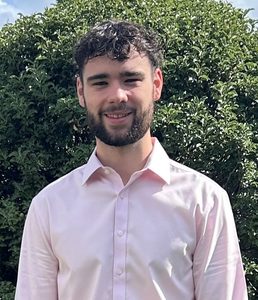
Name:
Ollie Pelham
Age (during placement):
20-21 years
Tell us a little about yourself and what you study?
I am a student at the university of Leicester studying a BSc in Computer Science which is a 4-year course with a year in Industry. I completed my first two years of study, and my third year was the year in Industry at Leicestershire Health Informatics Service (LHIS). Having now completed this placement, I have returned to university to do my final year from September.
What attracted you to apply for a placement at LHIS?
I was very keen to keep my placement in Leicester and close to the university. I knew that LHIS has many different strands of IT solutions and services and that it would operate within the NHS values and standards. LHIS has thousands of users across Leicestershire and is a well-established organisation, this would bring me lots of experience. I wanted to put some of the theory that I had learned in my first two years into practice in real life situations.
Tell us a little about your role and how your placement has been structured?
During my first few weeks in the placement, I undertook lots of training. I completed many online NHS specific training units to be compliant and continue in the placement.
The first department I was in was the Service Desk, solving technical issues. I was allocated someone in the office as my trainer and did a very specific 4-week training programme. With Service Desk I helped with a wide range of issues from password resets and VPN fixes to Installing software onto a client’s devices by remoting on to their computer.
In my sixth week I began doing 4 days a week on Service Desk and one day a week in the Infrastructure/Enterprise Department. I learned the first part of how to build a server using a virtual environment and setting up raids. I built my own virtual environment, set up disks, set up a RAC and did the raids for them.
After 3 months I was in the infrastructure/Enterprise department fulltime doing site visits to analyse a building for the networking capabilities. I visited the Cyber Security department and leaned about network scanning, testing and penetration testing.
I was taught about Mitel Phones. I took part in a team huddle as part of the project. I went to a health centre, and we built about 60 phones. We then deployed them and programmed the phones to do what was required. I was on site doing this for 4 days alongside also replacing broken routers in hospitals, surgeries etc around Leicester. I programmed and built a switch – then installed it into a server room. Windows server updates were completed remotely, and I was part of a meeting with Vodaphone to prepare a new wireless Wi-Fi.
In January, my fifth month, I moved to the IT infrastructure & support department in the asset management section. I re-imaged devices – with all the necessary software needed. I also spent time with the locality team on site visits to set up workstations as part of a site move for new people working there.
From my sixth month I was working on the service desk for 1- 2 hours at the start of each day and was back with the Enterprise department where I learned how to build firewalls for a network. My seventh month was spent working independently as I was given my own big project to run. I had a list of firewalls that needed updating and reaching the end of their life span across Leicestershire. From about 7 months, I also built servers for the data warehouse team suitable for SQL.
For the last couple of months,having completed the firewall project, I moved to Cyber Security to work under the Deputy Cyber Security Manager. I had to work out which main firewall was the target of the FW tunnel to determine which Rapid7 it should connect to, I onboarded the Watchguard firewalls onto Rapid7.
What are the main benefits of experiencing multiple departments?
Working across several departments gave me a very different experience than being in a single-team placement. Starting on Service Desk gave me good initial training and helped me get used to the different operating systems used. It gave me a bird’s-eye view of everything LHIS does and the problems that go wrong for users. Working in a range of departments gave me a broader skill set, It showed me how all the departments can be interlinked and work together. It gave me opportunity to work with a wider range of people and also helped me to understand better where my future interest might lie. I got to see lots of different aspects of how IT is used within the NHS and I made lots of site visits which helped me understand how important it is to the users.
What has been your biggest takeaway from this 10-month placement?
As a result of my 10-month placement, I have realised that I am capable of independent, accountable work: managing a live project, meeting deadlines, troubleshooting on-site, and upskilling others. These are qualities I can now speak to with confidence in applications and interviews, whatever direction my career takes.
One of my biggest take aways is that working life is not just about the technical skills I learned but a lot about working as part of a team and developing transferable human skills.
I learned that accuracy must always take priority over speed and that escalating early is a sign of professional judgement rather than failure. I realised that remaining calm under pressure is a skill that requires deliberate practice.
What advice would you give to other students considering a placement year?
I would suggest to other students considering a placement year that it is a really valuable opportunity, giving you firsthand experience of the world of work and allowing you to put theory into practice. A placement builds skills that can’t always be taught at university. A placement year allows you to see real consequences and meet real colleagues, not just hypothetical scenarios. It converts transferable-skill assertions into specific, provable experiences. A requirement from the university was to build a reflective journal each month and to do an end of year reflective portfolio – this was useful as it made me think about what I had done each month. The placement has given me invaluable experience to put on my CV. I would recommend that everybody considers a placement year if they can, I was really pleased to have been able to do mine as I really enjoyed moving around the different departments, meeting lots of lovely people and gaining a variety of experiences.